

Available NCAPs
- Raspberry PI runs an NCAP that support TIMs wired connect through UART, connected to the user’s network through WiFi.
- Raspberry PI runs an NCAP that support TIMs wireless connect through a 2.4MHz eZ430-RF2500 radio using an agnostic protocol, connected to the user’s network through WiFi.
Simple configuration
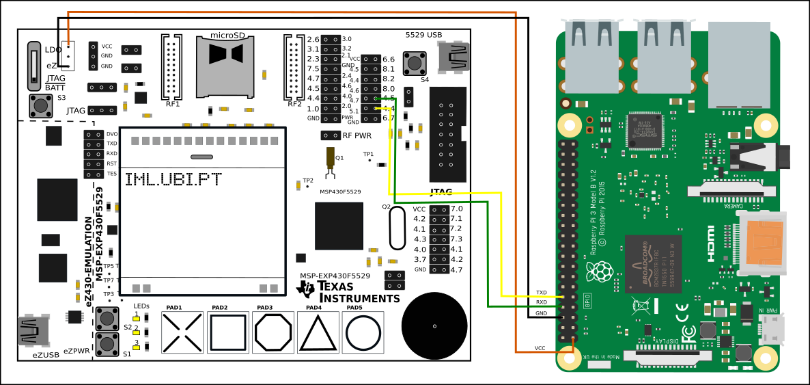
Fig. 1 - Wired connection between TIM and NCAP
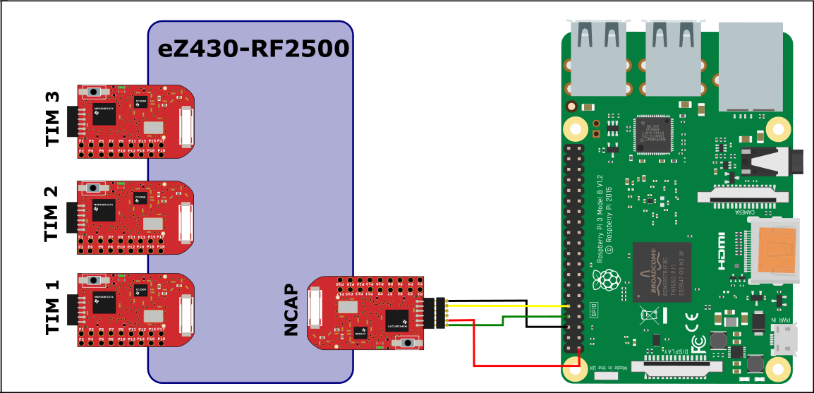
Fig. 2 - Wireless connection between a TIM and NCAP
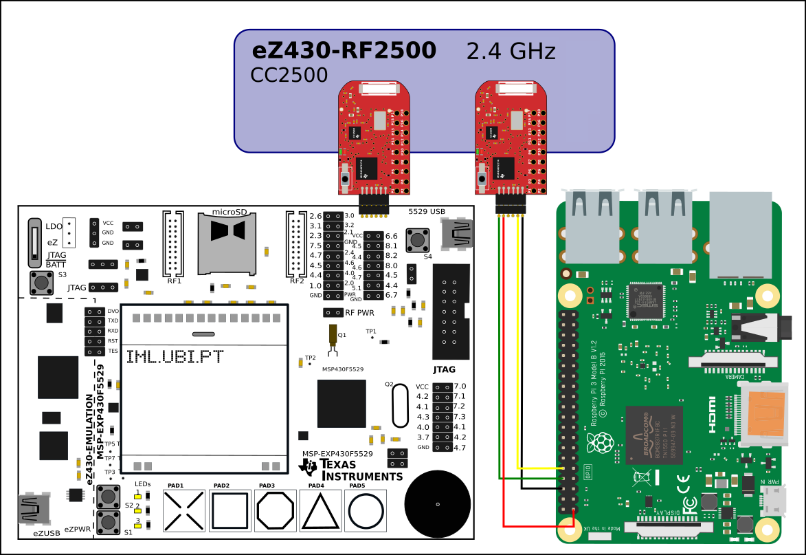
Fig. 3 - Wireless connection between a TIMs and NCAP
Advanced configuration
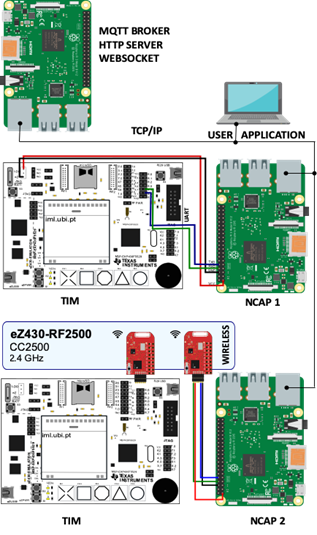
Available TIMs
- MSP430F5529 Experimenter Board runs a wired TIM that can connect to the NCAP through UART.
- MSP430F5529 Experimenter Board runs a wireless TIM that can connect to the NCAP through a 2.4MHz eZ430-RF2500 radio using an agnostic protocol.
- Z430-RF2500 runs a wireless TIM that can connect to the NCAP through a 2.4MHz eZ430-RF2500 radio using an agnostic protocol.
Other wireless NCAP to TIM connections, such as WiFi and Bluetooth, will be supported soon. Currently, available TIMs use the Texas Instruments MSP430 MCU family. Shortly, Micro Energy EFM32 MCU family will also be supported.
Available publishing/subscribing platform
Raspberry PI runs an MQTT broker connected to the Ethernet.
Available energy harvest mechanisms
- Vibration electromagnetic harvester.
- Vibration Piezoelectric harvester.
- Thermoelectric harvester.
- Microbial fuel cell harvester.
Energy Profiling
The CoE can also profile energy usage at TIM using the following tools:
- STMicroelectronics’ STM32 Power Shield allow any TIM energy profile.
- EnergyTrace™ technology for TIMs implemented with a Texas Instruments MSP430 and MSP432 microcontroller.
- Energy Profiler from Simplicity Studio for TIMs implemented with a Micro Energy EFM32 Microcontroller.
The CoE is working to provide EEMBC IoTMark and IoTMark-BLE benchmark testing as defined by the Embedded Microprocessor Benchmark Consortium.
Supported Integrated Development Interface
The CoE@UBI can develop TIMs firmware using the following Integrated Development Interface:
- Code Composer Studio for Texas Instruments
- Keil for ARM
- Simplicity Studio form Micro Energy
- IAR
NCAPS code is developed in Python